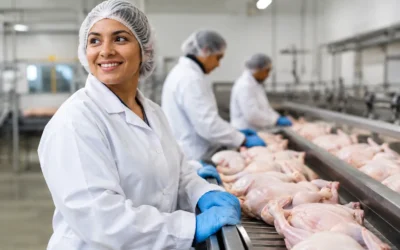
A sanitation gap does not stay in the sanitation department. It can delay pre-op release, hold up first shift, force production supervisors to pull people from the line, and put customer commitments at risk. Food sanitation staffing gives plant leaders a practical way to keep cleanup work fully manned without turning every absence, turnover issue, or volume spike into an operational emergency.
For food processors, poultry plants, packing operations, and cold-storage facilities, sanitation is not an afterthought. It is a production requirement. The right crew must be on site, trained on the work area, equipped with the required PPE, and accountable to the schedule before the next production run can begin.
Why Food Sanitation Staffing Affects Every Shift
Sanitation labor is often most visible when it is missing. A short-handed crew may leave equipment, drains, floors, conveyors, or processing areas behind schedule. Then quality, maintenance, and production teams are left waiting for work that should have been completed during the sanitation window.
The cost is more than the open position. When internal employees are reassigned to cover cleanup, production capacity drops somewhere else. When supervisors stay late to manage callouts, payroll costs rise. When a rushed crew skips established procedures, the operation takes on unnecessary food-safety and compliance exposure.
The challenge is especially acute in environments with demanding schedules. Poultry evisceration and deboning lines, fresh-cut operations, ready-to-eat facilities, packaging plants, and high-volume cold-chain operations cannot simply extend a sanitation window without affecting the next run. Every minute matters between final production, cleaning, inspection, and startup.
A managed staffing model changes the equation. Instead of receiving individual workers and carrying the full burden of attendance management, orientation, scheduling, and day-to-day oversight, the plant receives an organized crew built around the work that must be completed.
What an Effective Sanitation Crew Must Deliver
Sanitation work requires more than available hands. It requires disciplined execution under plant-specific rules. The exact crew structure depends on the facility, sanitation standard operating procedures, equipment layout, chemical program, and shift schedule, but the operating expectation stays the same: complete the assigned work safely, correctly, and on time.
A reliable food sanitation staffing plan starts with a clear scope. Leaders should identify which tasks need coverage, whether the crew supports pre-operational cleanup, operational sanitation, post-production sanitation, or all three, and what head count is necessary by department. A conveyor washdown team has different requirements than a crew assigned to foam, rinse, squeegee, palletize supplies, remove waste, or clean production rooms.
The crew also needs a defined chain of accountability. In a busy plant, instructions can get lost when every worker reports informally to a different department lead. On-site supervision gives the operation one point of contact for attendance, task assignments, safety reinforcement, and shift performance. It also helps managers identify coverage issues before they become a missed startup.
Training and safety discipline remain non-negotiable. Sanitation employees may work around wet floors, chemicals, moving equipment, sharp surfaces, confined work areas, and temperature-controlled environments. They must understand required PPE, lockout/tagout boundaries, chemical-handling rules, facility traffic patterns, and the site’s escalation process. Staffing support does not replace plant procedures. It should reinforce them from the first shift onward.
The Staffing Problems That Put Sanitation Behind
Most facilities do not struggle because they fail to recognize sanitation’s importance. They struggle because filling these roles consistently is difficult. The work is physically demanding, schedules may include nights and weekends, and turnover can be high. Recruiting one replacement at a time rarely keeps pace with daily operational needs.
Absenteeism is another pressure point. A single no-show may be manageable. Several no-shows on a sanitation shift can put a release schedule in jeopardy. Operations leaders then face an unwelcome choice: pay premium overtime, move production employees off their normal jobs, reduce the work scope, or accept a delayed start.
Seasonal demand creates a different problem. A facility may need added sanitation coverage after expanding a line, increasing shifts, ramping production before a holiday period, or taking on new customer volume. Waiting weeks for traditional hiring pipelines to produce qualified candidates can leave the operation exposed during the exact period when output matters most.
Compliance administration adds another layer. Payroll processing, timekeeping, onboarding records, workers’ compensation considerations, safety orientation, and attendance follow-up all require time from HR and operations. For plant leaders, the goal is not simply to find labor. The goal is to keep every line running at full speed while reducing the management load tied to that labor.
Build a Staffing Plan Around the Sanitation Schedule
A strong plan begins with the production calendar, not a generic job description. Start by mapping sanitation hours against shutdown times, pre-op inspections, maintenance windows, and first-shift startup. This shows where coverage is truly needed and where a small delay has the largest impact.
Next, define the roles by work area. One crew may be assigned to processing equipment and another to general plant sanitation. A facility may need dedicated support for pallet jack operation, waste removal, supply staging, or chemical-room organization. Separating responsibilities helps supervisors set clear expectations and avoid pulling skilled workers into unrelated tasks.
Then establish the minimum staffing level that protects the schedule. This is not always the average number of people used on a normal night. It should account for the workload, the completion deadline, expected absenteeism risk, and the consequences of falling behind. A plant with a narrow sanitation window may need a deeper bench than a facility with flexible production timing.
Finally, connect staffing to measurable operating results. Track attendance, fill rate, overtime hours, sanitation completion timing, pre-op readiness, and turnover. These metrics show whether the labor strategy is improving throughput or simply filling a short-term gap. If overtime remains high or startup delays continue, the head count, crew mix, supervision level, or shift structure may need adjustment.
When Managed Crews Make the Most Sense
Direct hiring can work well when a facility has stable demand, a strong internal recruiting team, and supervisors with capacity to manage onboarding and daily attendance. But it may not be the right answer when urgent coverage is needed, turnover is draining internal resources, or a new shift must be staffed quickly.
Managed crews are particularly useful when the plant needs a group of employees who can be deployed into an established workflow with supervision and a clear attendance structure. The staffing partner handles recruiting and workforce oversight while the facility retains control of its sanitation procedures, food-safety requirements, production schedule, and plant standards.
Enterprise Staffing supports this model with OSHA-compliant crews, safety orientation, PPE support, time-clock integration, and on-site supervision. The purpose is operational continuity: give plant leadership a staffed, accountable team that fits the schedule instead of another stack of applicants to process.
There are trade-offs to consider. A managed crew works best when the facility communicates shift times, work scope, access requirements, training expectations, and any changes to production plans early. The partner can move faster and manage performance better when plant leadership provides clear direction. Staffing is most effective as an operating partnership, not a last-minute handoff with incomplete information.
Protect the Sanitation Window Before It Becomes a Crisis
The best time to address a sanitation labor gap is before a missed shift forces a production decision. Review upcoming volume changes, vacation periods, known turnover, new line launches, and seasonal peaks. If the operation is relying on repeated overtime or pulling workers from other departments to finish sanitation, the current labor model is already under strain.
A disciplined food sanitation staffing plan gives leaders room to manage the plant instead of reacting to the next callout. With the right crew size, supervision, safety expectations, and timekeeping structure in place, sanitation can stay on schedule and production can start when it is supposed to.
Your sanitation window is part of your production capacity. Staff it with the same urgency you bring to the line.