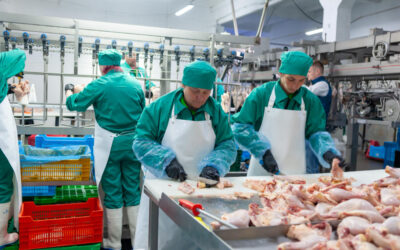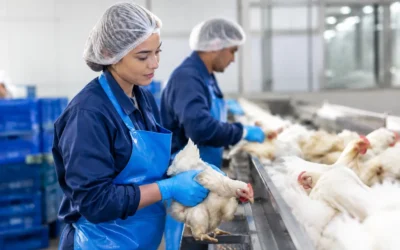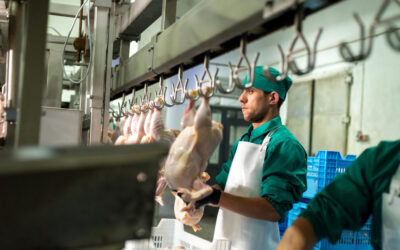
A six-person attendance gap can put an entire poultry line behind before the first break. Deboning slows, packing backs up, sanitation windows tighten, and supervisors get pulled away from production to call workers, reshuffle stations, and approve overtime. Poultry processing staffing is not simply a recruiting function in that moment. It is a production continuity requirement.
For high-volume poultry operations, labor coverage has to match the pace and discipline of the plant floor. The right workforce partner does more than fill a head-count request. It supplies prepared crews, clear supervision, safety accountability, and the operational oversight needed to keep every line running at full speed.
Why Poultry Labor Gaps Carry a Bigger Cost
Poultry processing is a connected operation. A gap at live hang, evisceration, trimming, deboning, cut-up, packaging, palletizing, or cold storage does not stay isolated for long. When one station falls behind, upstream labor waits, downstream product accumulates, and line balance deteriorates.
The immediate cost is visible in overtime, reduced throughput, and supervisors working outside their core responsibilities. The less visible costs can be just as serious: rushed work, inconsistent quality checks, preventable safety incidents, missed sanitation timing, and higher turnover among the people who are asked to carry the shortage every day.
Traditional temporary staffing can create another burden. A plant receives individual workers, but internal leaders still must orient them, confirm documentation, assign stations, monitor attendance, manage performance, and replace no-shows. That model may work for a small, predictable need. It often breaks down when a facility needs a dependable crew across multiple shifts or has a sudden production increase.
Poultry Processing Staffing Must Be Built Around the Line
Effective poultry processing staffing starts with the work itself. A staffing plan should account for each department’s required head count, skill level, shift schedule, production target, PPE requirements, break rotation, transportation realities, and supervision needs.
A crew assigned to bagging and packaging has a different pace and training profile than a team supporting deboning or evisceration. Cold-room assignments require another layer of readiness. Treating all openings as interchangeable produces inconsistent performance and increases the risk of placing people where they cannot safely sustain the work.
Plant leadership should also separate baseline staffing from surge capacity. Baseline staffing covers the labor required to run normal schedules without relying on constant overtime. Surge capacity covers seasonal demand, promotions, major customer orders, holiday production, absenteeism spikes, and unexpected turnover. When both needs are planned, managers can avoid the daily scramble of trying to fill a structural labor gap with emergency calls.
It depends on the facility, but a useful staffing plan often maps coverage by department and shift rather than using one plant-wide number. A 30-person shortfall on first shift might be manageable if it is distributed across lower-risk packaging functions. A 10-person shortfall in a critical cutting area may put the entire day’s output at risk. The operational impact matters more than the raw number.
Start With the Real Head-Count Gap
A useful request is specific: the number of people needed, start date, shift times, department, expected duration, physical demands, required PPE, and time-clock process. The faster those details are shared, the faster a staffing partner can build a crew that fits the workflow.
That does not mean every detail must be perfect before asking for help. When a line is at risk, plant managers need a quick staffing plan, not a lengthy intake process. A capable provider should clarify the essentials, identify the highest-priority stations, and begin deployment without slowing down the operation.
Managed Crews Reduce the Burden on Supervisors
The difference between sending labor and managing labor is significant in a poultry facility. Individual placements may solve an immediate vacancy. Managed crews are designed to support the operation over time.
With a managed-crew model, the staffing provider handles recruiting, pre-screening, onboarding support, safety orientation, PPE coordination, payroll administration, attendance follow-up, and on-site workforce oversight. The plant’s supervisors retain control over production standards and daily assignments, while the labor partner takes accountability for keeping the crew staffed and work-ready.
This structure gives frontline supervisors time back. Instead of spending the first hour of every shift locating replacements and answering basic employment questions, they can focus on line balance, quality, yield, safety, and output. That is where plant leadership creates value.
Enterprise Staffing deploys supervised crews that can be integrated with established production schedules, safety expectations, and time-clock systems quickly, including urgent requirements that may need coverage within 48 hours. The goal is not to add another vendor relationship for the plant to manage. It is to provide an accountable labor operation that supports stable throughput.
Safety and Compliance Cannot Be Added Later
Poultry processing demands physical consistency and close attention to safety. Wet floors, sharp tools, repetitive motion, cold environments, machinery, chemical exposure, and fast-moving conveyor systems all require disciplined orientation and active supervision.
A workforce plan should establish how workers receive site-specific safety instruction, when PPE is issued, how injuries are reported, who verifies time records, and how language or communication barriers are addressed. These details affect more than compliance. They shape attendance, retention, worker confidence, and the facility’s ability to maintain a reliable crew.
The trade-off is clear. Fast deployment without preparation may fill badges but create safety exposure and early turnover. Overly slow onboarding can leave a production line understaffed for weeks. The right approach moves quickly while keeping orientation, PPE, documentation, and worksite expectations in place from day one.
Compliance support also reduces pressure on internal HR teams. Payroll classification, employment documentation, wage administration, and workforce recordkeeping can consume significant time, especially when the plant is adding workers across shifts. A payroll-inclusive labor model creates more predictable cost visibility and reduces the administrative load that comes with a large hourly workforce.
Measure Staffing by Output, Not Just Fill Rate
A filled requisition is not necessarily a successful staffing outcome. A poultry facility needs labor that arrives consistently, works safely, remains productive, and can be replaced quickly when attendance changes.
Operations leaders should review staffing performance against production realities. Attendance rate, early turnover, overtime hours, open positions by shift, time-to-replace, safety observations, and line-specific throughput all reveal whether the labor plan is protecting output. If a crew is fully staffed on paper but the same stations repeatedly fall behind, the issue may be training, assignment fit, supervision, or scheduling rather than total head count.
Regular communication between the plant and staffing partner matters here. A brief, disciplined check-in can identify upcoming demand, repeated absenteeism patterns, difficult stations, schedule changes, and training needs before they become a missed production target. The staffing provider should bring solutions, not wait for the plant to report a problem after the line has already slowed.
When Internal Hiring Is Enough and When It Is Not
Internal hiring remains valuable for permanent leadership roles, specialized maintenance positions, and core roles where long-term plant knowledge is essential. A facility with low turnover, predictable demand, and adequate HR capacity may be able to recruit much of its own hourly workforce successfully.
But internal hiring becomes strained when turnover rises, applications slow, attendance is inconsistent, or demand shifts faster than the HR team can respond. It can also become inefficient when supervisors are repeatedly pulled into labor management instead of production management.
Contract labor is not a substitute for fixing every workplace issue. Pay, schedules, transportation access, supervisor conduct, and working conditions still influence retention. Yet a managed staffing model gives the operation a practical buffer while leaders address those longer-term factors. It protects the line from carrying the full cost of every recruiting delay or no-show.
The strongest poultry staffing strategy treats labor like any other critical production input. Know the head-count gap before it threatens the schedule, define the stations that cannot go uncovered, and require accountability for safety, attendance, and replacement speed. When the next shift starts, the standard should be simple: fully manned crews, clear oversight, and no uncertainty about who is keeping the line moving.