A production line does not wait for job postings to convert into hires. When absenteeism climbs, an order volume jumps, or turnover leaves critical stations uncovered, the decision between internal recruiting versus labor outsourcing becomes an operations decision, not simply an HR preference. The real question is whether your current labor model can keep every line running at full speed without adding overtime, safety risk, or compliance exposure.
For manufacturers, food processors, warehouses, poultry operations, and agricultural employers, both approaches have a place. The right choice depends on the urgency of the head-count gap, the consistency of demand, the management capacity on the floor, and the cost of lost output.
What Internal Recruiting Actually Requires
Internal recruiting gives your company direct control over candidate sourcing, interviews, hiring decisions, onboarding, payroll, attendance management, and retention. For stable, long-term roles with predictable head count, that control can be valuable. You build your own workforce culture, develop employees over time, and retain institutional knowledge within the facility.
That model works best when your operation has enough HR capacity to maintain a reliable hiring pipeline. It also requires supervisors who can absorb the daily work that follows a new hire: training, schedule changes, call-offs, discipline, replacement hiring, and performance follow-up.
The hidden issue is timing. A plant may need 25 assemblers, packers, pick-pack workers, or palletizers by the next shift. Internal recruiting rarely moves at that speed. Advertising, screening, background checks, orientation, paperwork, and first-day no-shows can turn an immediate production need into a multiweek staffing problem.
Internal hiring also places payroll taxes, workers’ compensation administration, benefits eligibility, unemployment claims, and employment-record compliance directly on your team. None of these responsibilities are optional. When the workforce expands quickly, administrative pressure expands with it.
When Labor Outsourcing Protects Production Uptime
Labor outsourcing transfers much of the recruiting and employment administration to a workforce partner. But not all outsourced labor models are the same. A traditional temporary agency may send individual workers and leave your supervisors to manage attendance, coaching, replacements, safety reinforcement, and daily deployment.
A managed crew model is built for a different operating reality. The provider recruits, screens, orients, equips, and supervises a coordinated work crew that can step into defined production workflows. The focus is not filling a requisition. The focus is keeping output stable at the stations that cannot sit empty.
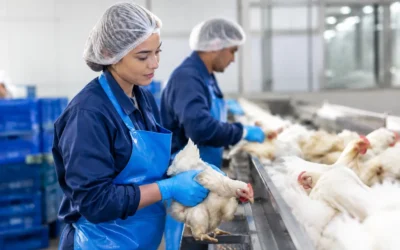
For a warehouse, that may mean receiving, sorting, kitting, pick-pack, loading, and palletizing. In food and poultry processing, it may mean deboning, evisceration support, trimming, packaging, sanitation, or hatchery work. In light manufacturing, it may mean assembly, labeling, inspection, material handling, and line support.
The operational advantage is speed with accountability. A capable labor partner can deploy workers quickly, integrate with your time-clock process, provide required personal protective equipment, reinforce site rules, and maintain an on-site point of supervision. If attendance drops or demand rises, the provider owns the response instead of handing the problem back to your production manager.
Internal Recruiting Versus Labor Outsourcing: The Cost Test
Comparing hourly bill rates to employee wage rates is not enough. A lower wage on paper can become the more expensive option if it brings overtime, vacancy-related downtime, excess supervisor labor, repeated onboarding, or production misses.
Start with the cost of an open position. If one missing worker slows a packaging line, forces teammates into overtime, or causes an order to ship late, the financial impact can exceed the apparent savings of handling everything internally. The same is true when supervisors spend hours every week chasing attendance, filling schedules, and retraining replacement workers instead of managing quality, throughput, and safety.
Internal recruiting often has lower direct labor cost for established positions that remain filled and productive over time. Labor outsourcing can be the stronger cost-control choice when demand fluctuates, turnover is persistent, or a fast labor response prevents downtime. The difference is not just what labor costs per hour. It is what instability costs per shift.
A disciplined comparison should account for recruiting spend, HR time, onboarding time, payroll burden, workers’ compensation, overtime, absenteeism, turnover, supervisor workload, safety supplies, and the value of lost production. When those costs are visible, the decision becomes clearer.
Control Is Not the Same as Ownership
Some operations leaders hesitate to outsource because they do not want to lose control of the floor. That concern is valid if the provider operates at a distance. It is less relevant when crews are managed on-site and aligned to your schedules, work instructions, safety requirements, and production targets.
Your operation should always retain control of production standards. You determine the shift plan, output expectations, facility rules, quality requirements, and the work sequence. A strong staffing partner supports that control by ensuring the crew arrives prepared, understands the assignment, follows safety direction, and has active oversight throughout the shift.
The key is defining responsibilities before the crew starts. Who handles safety orientation? Who provides PPE? Who tracks hours? Who responds to a no-show? Who coaches performance? Who replaces workers when volume changes? A vague answer in any of these areas creates friction. A managed labor model should make each responsibility clear and measurable.
Compliance and Safety Cannot Be an Afterthought
High-output environments create real exposure. New workers may be unfamiliar with equipment, traffic patterns, cold environments, sanitation procedures, ergonomic risks, or facility-specific PPE requirements. A rushed hiring process without disciplined orientation can create more than a staffing problem.
Internal teams can manage these requirements well when they have the staffing and systems to do so consistently. However, rapid hiring waves often strain even experienced HR and safety teams. Orientation rooms fill up, documentation falls behind, and supervisors are forced to teach basics while trying to maintain line speed.
Labor outsourcing should reduce this pressure, not add to it. Look for a provider that treats OSHA compliance, safety orientation, PPE, workforce documentation, and supervisor presence as part of the service model. Payroll-inclusive labor is useful, but it is not enough if the provider cannot maintain safe, accountable crews on your floor.
For operations across the Southeast and multistate facilities, consistency matters even more. A partner should be able to apply the same deployment discipline whether the need is a short-notice packaging crew, a seasonal agricultural workforce, or ongoing warehouse support.
Choose the Model Based on the Workload
Internal recruiting is usually the better fit when head count is stable, roles are highly specialized, hiring lead time is available, and your HR and supervisory teams have room to manage the full employment cycle. It is also a sound choice for positions where long-term employee development is central to the operation.
Labor outsourcing is often the better fit when labor demand changes quickly, production cannot wait, absenteeism is disrupting schedules, or your team is already stretched by hiring and attendance management. It is particularly effective for labor-intensive, repeatable workflows where a supervised crew can be deployed against a clear production plan.
Many successful operations use both. They maintain an internal core workforce for leadership, specialized skills, and long-term continuity, then use outsourced labor to cover seasonal peaks, new contracts, shift expansions, unexpected turnover, and temporary head-count gaps. This hybrid approach keeps the operation flexible without treating every staffing need as permanent.
Questions to Ask Before You Decide
Before expanding internal hiring or bringing in outsourced labor, pressure-test the situation with practical questions. How many workers are needed, and by what shift? Which stations create the greatest risk if left uncovered? Is the shortage temporary, seasonal, or permanent? How much supervisor time is already being spent on attendance and replacement hiring? What does one hour of reduced throughput cost?
Then evaluate the provider model, not just the rate. Can the partner deploy within the timeframe your operation requires? Are workers safety-oriented before entering the facility? Is there on-site supervision? Can the crew integrate with your time-clock system and production schedule? Is there a clear plan for call-offs, replacements, and volume changes?
Enterprise Staffing is built for employers that need more than names on a roster. Managed crews, on-site oversight, safety discipline, and rapid deployment give operations leaders a practical way to stabilize labor without expanding internal HR burden.
When your next head-count gap appears, do not measure the decision only by the cost to hire. Measure it by the cost of a line that cannot run. The right labor model is the one that puts trained, accountable people at the workstations that keep your operation moving.