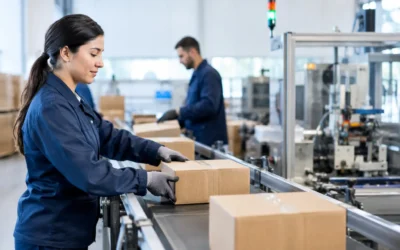
A labor gap on second shift is not an HR problem first. It is a production problem. When a packaging line, deboning operation, warehouse pick line, or assembly cell is short by 12 people, output slows, supervisors get pulled off the floor, and overtime starts stacking up. The decision between direct hire versus contract crews determines who carries that operational pressure and how quickly the operation can recover.
For many high-output employers, the best answer is not one model forever. It is a labor strategy built around the work, the volatility of demand, the management capacity on site, and the cost of a line running below target.
Direct Hire Versus Contract Crews: The Operating Difference
Direct hiring means your company recruits, interviews, onboards, trains, pays, schedules, supervises, and retains each employee. This approach gives you direct control over the employment relationship. It can be the right fit for stable, year-round roles where institutional knowledge, technical skill, and long-term retention are central to the operation.
Contract crews operate differently. A staffing partner recruits and deploys a ready workforce, then provides the workforce oversight required to keep that crew present, oriented, compliant, and productive. In a managed-crew model, the provider is not simply sending names to a site. The provider is accountable for assembling a crew that can enter the workflow, follow plant rules, clock in through the required system, and support the required head count.
That distinction matters when an operation cannot afford to wait weeks for job postings, interviews, orientation, and no-shows to sort themselves out. A direct-hire process is designed to build an internal workforce. A contract crew is designed to protect throughput when labor demand moves faster than internal hiring can respond.
When Direct Hiring Makes Operational Sense
Direct hire is often the better long-term choice for core roles that require deep process knowledge, advanced equipment qualifications, leadership responsibility, or a clear internal career path. Maintenance technicians, lead operators, quality specialists, plant leadership, and roles tied to proprietary processes generally benefit from direct employment.
It also works well when head count is predictable. If a facility has low turnover, dependable attendance, consistent production volume, and enough internal recruiting and supervisory capacity, adding employees directly can support a stable team culture.
But the real cost of direct hiring extends beyond an hourly wage. Operations leaders need to account for recruiting time, background checks, onboarding, payroll administration, workers’ compensation exposure, attendance management, replacement hiring, training time, and supervisor hours spent filling gaps. The cost becomes especially visible when turnover is high or when applicants accept the job but do not remain long enough to become productive.
Direct hire can deliver strong value. It becomes less efficient when the operation needs labor immediately, demand changes by the week, or the internal team is already stretched managing production, safety, and attendance issues.
Where Contract Crews Protect Uptime
Contract crews are built for labor-intensive work where volume is real, schedules are demanding, and a missing crew can put the whole shift behind. Warehousing, kitting, palletizing, packaging, assembly, food processing, poultry processing, hatcheries, and agricultural production often face this reality.
A managed contract crew gives leaders a faster route to a fully manned operation. The staffing partner handles recruiting and payroll while coordinating safety orientation, personal protective equipment, attendance expectations, and on-site crew oversight. Instead of asking a production supervisor to become a recruiter at 4:30 a.m., the operation has a defined workforce partner responsible for restoring coverage.
The strongest use case is a sudden or recurring head-count gap. A customer order spikes. Seasonal volume arrives early. Absenteeism rises. A new line opens. A plant needs weekend coverage without burning out its core team. In these situations, contract crews can be deployed against a clear production requirement: number of people, shift schedule, tasks, start date, safety rules, and time-clock process.
Speed is only useful if the workforce is managed correctly after arrival. An unsupervised group of workers can create more strain for the floor team. A disciplined crew model should include active oversight, clear job assignments, safety alignment, and a process for replacing absences before they become lost production hours.
Compare the Costs That Actually Affect the Line
Hourly bill rate is not the full comparison. A lower wage can become the more expensive choice if it produces chronic vacancies, excessive overtime, safety incidents, or constant retraining. Operations leaders should measure labor cost against labor performance.
With direct hiring, the company controls compensation and benefits but also absorbs the cost of recruiting, payroll, unemployment administration, employee relations, compliance documentation, and turnover. The exact burden varies by state, role, and hiring volume, but it is rarely insignificant in high-churn production environments.
With contract crews, the rate is more consolidated. Payroll, recruiting, workforce administration, and many employer-side obligations are bundled into the staffing arrangement. That can improve cost predictability, particularly during peak demand periods. It does not mean contract labor is automatically less expensive on every shift. It means the operation can compare a known labor cost against the true cost of vacancies and internal hiring strain.
Ask a more useful question: What does one unfilled position cost during a 10-hour shift? Include lost units, overtime, slower changeovers, supervisor time, late shipments, and pressure placed on the rest of the crew. For many plants and distribution operations, that number changes the staffing decision quickly.
Control, Safety, and Compliance Are Not the Same Thing
Some employers assume direct hire provides more control because every worker is on the company payroll. Direct employment does provide direct control over the employment relationship. But operational control on the floor depends on whether leaders have the bandwidth to train, supervise, document, and follow up consistently.
Contract crews require a clear division of responsibility. The client sets production standards, work instructions, facility rules, and site-specific safety requirements. The staffing partner supplies qualified labor, reinforces attendance and conduct expectations, manages its employment responsibilities, and maintains active communication with site leadership.
For food, poultry, manufacturing, and warehouse environments, safety cannot be treated as a one-time orientation event. Workers need proper PPE, task-specific instruction, reporting channels, and supervisors who address unsafe behavior before it becomes an incident. OSHA compliance also requires discipline in documentation, training, and accountability.
The right partner reduces compliance anxiety by making those responsibilities visible and repeatable. Before deployment, establish how workers will be oriented, who supplies PPE, how incidents are reported, how time is captured, who addresses attendance, and how replacements are requested. If those answers are vague, the labor plan is not ready for the floor.
Use a Blended Workforce When Demand Is Uneven
Many of the most stable operations use direct hire and contract crews together. Their internal team protects critical knowledge and supports daily leadership. Contract labor adds capacity around the pressure points that would otherwise force overtime, delay orders, or leave lines under-manned.
A warehouse may keep its core shipping leads, inventory team, and forklift operators in direct roles while using contract crews for pick-pack, repack, labeling, and palletizing during a customer surge. A food processor may retain experienced line leads and quality personnel while bringing in managed crews for seasonal packaging volume. An assembly operation may direct-hire its technicians and use contract crews to support repetitive assembly, sorting, and material handling.
This model works when the scope is specific. Define the tasks, expected daily head count, productivity standards, shift windows, break coverage, safety requirements, and escalation path. Contract crews perform best when they are integrated into an organized production plan, not treated as labor that will somehow solve an undefined problem.
Questions to Settle Before You Choose
Start with the production requirement, not the staffing label. How many people are needed by shift? Which workstations cannot run short? How quickly must the head count be in place? Is the need permanent, seasonal, or tied to a short-term order? Can the current supervisory team absorb onboarding and attendance management without losing focus on output?
Then look at the risk. If five people do not show up tomorrow, can the line still meet its target? If not, the operation needs a labor model with rapid replacement capacity. If demand has been flat and predictable for years, direct hiring may be the more logical investment. If volume changes, turnover is persistent, or overtime is becoming the default solution, managed contract crews deserve a serious evaluation.
The goal is not to choose the cheapest labor source on paper. The goal is to keep every line running at full speed with safe, accountable people in the positions that matter.
When a head-count gap threatens tomorrow’s schedule, move before the gap becomes lost output. Enterprise Staffing helps operations build a staffing plan around the work on the floor, the safety rules at the site, and the production numbers the shift must hit.