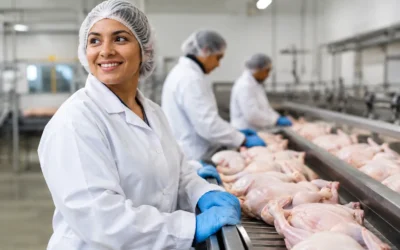
A new temporary worker should not learn your plant’s hazards by watching the person beside them for five minutes. On a packaging line, in a cold-storage warehouse, or near a deboning operation, that shortcut can turn a head-count solution into an injury, a shutdown, or a reportable incident. Effective OSHA orientation for temporary workers is an operating requirement: it gives each worker the information, equipment, and supervision needed to work safely before they affect output.
For production leaders, the objective is clear. Bring workers onto the floor quickly without lowering the safety standard that protects your people, your throughput, and your compliance position. That requires a defined handoff between the staffing provider, the host employer, and the front-line supervisor.
Why temporary-worker orientation needs its own process
Temporary workers often enter the highest-pressure parts of an operation: seasonal surges, absenteeism gaps, urgent orders, second shifts, and departments with persistent turnover. They may be experienced workers, but experience in another facility does not mean they understand your traffic patterns, lockout procedures, sanitation requirements, line speeds, emergency exits, or reporting chain.
A forklift operator may know how to operate a truck but not your pedestrian zones. A food-processing worker may understand cut-resistant gloves but not the sanitation break procedures or chemical labeling system at your facility. A worker assigned to palletizing may not recognize the pinch points around a specific conveyor. Site-specific knowledge is the difference.
OSHA treats temporary-worker safety as a shared responsibility. The staffing agency and host employer must communicate about workplace hazards and who will provide required training, PPE, and oversight. The host employer generally controls the worksite and understands its hazards best. The staffing partner must still prepare workers, verify qualifications where applicable, and ensure the assignment matches the worker’s capabilities.
A contract does not remove either party’s responsibility. If the process is unclear, gaps show up where they matter most: at the start of a shift, during a line change, or when a worker faces an unfamiliar task.
OSHA orientation for temporary workers starts before day one
The strongest orientation process begins before a crew reaches the gate. A staffing provider should collect enough assignment detail to place the right workers and prepare them for the conditions ahead. “General labor” is not a sufficient job description when the work involves refrigerated environments, powered industrial trucks, chemicals, sharp tools, repetitive motion, or heavy lifting.
Before deployment, define the department, task, shift, physical demands, expected PPE, hazard exposures, required credentials, language needs, and supervisor of record. Also confirm whether the worker will enter restricted areas, operate equipment, work at heights, clean production equipment, or handle regulated materials.
This pre-assignment step protects speed. It is faster to send a prepared crew to a known need than to pull workers off the floor after they discover they cannot safely perform the task. It also prevents a common compliance failure: assigning a worker to duties beyond the scope of the training they received.
For managed crews, the staffing partner should arrive with an accurate roster, documented pre-screening, and a clear understanding of who owns each part of the orientation. Enterprise Staffing uses this kind of operational handoff to move crews into established workflows without leaving plant leadership to rebuild the process shift by shift.
Separate general safety from site-specific hazards
A useful orientation has two layers. The first covers broad expectations that apply across assignments. The second is delivered at the host site and addresses the exact hazards of the worker’s department and task.
General orientation can cover reporting injuries immediately, using PPE correctly, recognizing unsafe conditions, avoiding horseplay, following supervisor direction, and understanding the worker’s right to raise safety concerns. It should also establish that a worker is never expected to perform a task they have not been trained or authorized to do.
Site-specific orientation must be more concrete. Show workers where to enter, where to clock in, where to stage, and how to reach their supervisor. Walk them through evacuation routes, muster points, first-aid locations, eyewash stations, break areas, and restricted zones. Explain alarms in plain language. If an alarm sounds, workers need to know whether to evacuate, shelter, stop equipment, or report to a designated point.
Then address the hazards of the actual job. A warehouse picker needs different instruction than a hatchery worker. A worker on a poultry line needs different instruction than someone doing kitting in an assembly department. Do not rely on a one-size-fits-all video to cover the difference.
Train at the point of work
Classroom or breakroom orientation creates the baseline. The line-side demonstration confirms that the worker can apply it. Before the worker starts independently, a qualified supervisor should show the task, point out hazard zones, explain the safe method, and observe the worker performing the work.
This matters most around equipment. Workers should understand guarding, emergency stops, conveyor pinch points, machine startup procedures, and the limits of their authority. They should know that clearing a jam, cleaning moving equipment, removing guards, or entering a restricted area may require a trained and authorized employee. No production target justifies bypassing those controls.
The same principle applies to PPE. Handing out gloves, hearing protection, face shields, aprons, or slip-resistant footwear is not the full requirement. Workers must know when the equipment is required, how it fits, what it protects against, and when it needs replacement. In food and agricultural operations, they also need to understand how PPE affects sanitation and cross-contamination controls.
For workers who do not speak English as their primary language, orientation must be understood, not simply delivered. Use qualified bilingual trainers, interpreters, visual demonstrations, or translated materials as appropriate. Ask workers to explain key instructions back or demonstrate the task. A signature alone does not prove comprehension.
Build a clean handoff between the staffing partner and host site
Orientation breaks down when everyone assumes someone else covered it. The fix is a short, documented division of responsibilities before the shift begins. The details will vary by operation, but the handoff should answer four questions:
- What hazards and task-specific instructions will the host employer provide?
- What pre-assignment safety training and worker records will the staffing provider provide?
- Who issues, fits, and replaces required PPE?
- Who receives reports of injuries, near misses, hazards, attendance problems, or job changes?
Keep the answer accessible to the people running the shift, not only in an HR file. The production supervisor, site lead, safety manager, and staffing coordinator should know exactly who to call when a task changes or an incident occurs.
Job changes deserve special attention. A temporary worker oriented for packing cannot automatically be moved to forklift operation, sanitation, maintenance support, or a more hazardous line because the department is short-handed. Reassess the assignment, confirm qualifications, and provide the training required for the new work before the move occurs.
Supervision keeps the orientation alive
Orientation is not a one-time event. It is the first control in a supervision system. New workers need close observation during their first hours and first several shifts, especially where line pace, equipment movement, cold conditions, or unfamiliar production standards raise the risk of error.
Supervisors should correct unsafe behavior quickly and specifically. “Be careful” does not tell a worker what to change. “Stay outside the marked forklift aisle until the operator stops and signals you through” does. Clear direction protects workers while preserving the pace of the department.
Daily huddles are useful when they are short and relevant. Cover the day’s changing conditions: wet floors, maintenance activity, altered traffic routes, new product runs, heat stress, staffing changes, or a recent near miss. If crews are rotating across departments, communicate that change before workers move.
Track early warning signals as operational data. Repeat questions, PPE replacement rates, near misses, first-week injuries, late reporting, and frequent reassignment can expose a weak orientation process before it becomes a serious event. The right response may be more line-side coaching, clearer signage, a different placement, or added supervision. It depends on the hazard and the worker’s experience level.
Document what matters without slowing the floor
Good documentation is practical, not paperwork for its own sake. Maintain training dates, topics covered, trainer names, worker acknowledgments, qualifications, PPE issuance when relevant, and records of task changes or refresher instruction. If an incident occurs, these records help the operation understand what happened and whether the worker received the information needed to work safely.
Documentation should support the floor, not delay it. A standardized orientation checklist, department-specific hazard sheet, and supervisor signoff can create consistency across shifts without adding unnecessary administrative burden. Digital records can help, but only if supervisors can complete them quickly and retrieve them when needed.
The test is simple: can your operation show what the worker was assigned to do, what hazards were communicated, who trained them, and who supervised them? If the answer is uncertain, the process needs tightening.
A fully manned line is only a win when every worker is ready for the work in front of them. Treat orientation as part of production readiness, and your operation gains more than compliance. You gain a safer crew, steadier output, and fewer surprises when the next urgent labor gap hits.